CLASSIC CONNECTIONS
Prince Khalid Abdullah’s Juddmonte Farms have become synonomous
with group success in Europe and North America in the past 25
years. Its stallion operation is based at Banstead Manor Stud on
the outskirts of the village of Cheveley, some four miles out of
Newmarket.
The name ‘Banstead’ has been associated with the area since
1506. In 1587, the last Thomas Banstead sold the Manor and all of
his land to Sir John Cotton. In 1895 it passed to Harry McCalmont,
then owner of the Cheveley estate, and in 1925 to associates of
Henry Ernest Morriss. As Banstead Manor Stud Ltd., the estate was
owned by members of the Morriss family until 1987, when it was
purchased by Juddmonte Farms.
The house called Banstead Manor occupies a former moated site of
medieval origin. The original house was demolished in 1926 and
replaced in 1927 with a larger Lutyens-influenced house based on
plans originally drawn up for a residence in Shanghai. It has
sweeping roofs, prominent chimney stacks, and mullioned windows. It
is also set in reverse, with the ‘front’ of the house facing away
from the drive.
Abdullah's racing operation began modestly enough with four
yearling purchases in 1977. His first win came two years later, and
in 1980, his Known Fact was awarded the 2,000 Guineas on the
disqualification of Nureyev. Since then, Juddmonte has produced
more than 50 Group or Grade I winners and in many instances, trace
back to some of the first mares purchased by the operation.
Banstead Manor stud covers 373 acres of land, of which 50 are
set aside for the stallion unit. The Stud operates on the
successful ‘walking-in’ system for visiting mares. In a throwback
to the Chinese connections of the Morriss era, a Chinese fertility
symbol still remains at the stallion unit, which is approached via
na avenue of Gingko trees, another Chinese fertility omen.
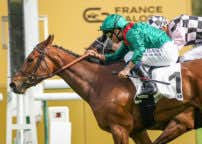
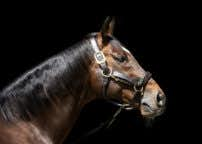
Rainbow Quest was one of the first major winners to campaign in
the pink, green and white colours. His victories included the
Coronation Cup and in shades of Known Fact, he was awarded the Prix
de l’Arc de Triomphe after a bumping duel in the straight with
Sagace. At stud, he got the Derby winner Quest For Fame in his
first crop and since then has been a constant source of classic
middle-distance winners.
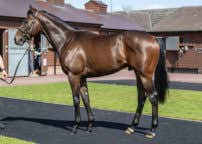
Now 25, Rainbow Quest is a member of the elite club of stallions
to have sired a Derby winner as well as the broodmare sire of a
Derby winner following the wins of Kris Kin and North Light.
Rainbow Quest’s influence as a broodmare sire also extends through
the unbeaten 2000 Guineas Footstepsinthesands and the Group 1
winner Rakti, this quartet all at stud. Quest For Fame came close
to siring a Derby winner when his son De Beers finished second in
the Australian Derby at Easter and his 2000 Guineas winning son
Spectrum, now at stud in South Africa, sired the 2004 Australian
Oaks heroine, Wild Iris.
MANNA - BANSTEAD MANOR'S FIRST DERBY WINNER
In the Summer of 1923, Harry Morriss sent instructions
from Shanghai to trainer Fred Darling, ordering him to buy the colt
he liked best at Doncaster Sales. Darling decided upon the colt by
Phalaris out of Waffles - and he was not alone in this
choice.
Geroge Lambton, bidding for the Aga Khan, cried enough at 6,300
guineas. The colt was not the biggest in the sale - indeed, critics
thought him too small - but Darling remarked " I do not mind
a yearling being on the small side, so long as he is as beautifully
balanced as this one."
Darling's judgement was to prove spot-on and the colt, the most
expensive yearling colt of 1923, was named Manna and went on to win
the 2,000 Guineas and Derby.
Manna was not the first Classic winner bred by James Maher at his
Confey Stud near Dublin. He was also repsonsible for the St Leger
winner Caligua and Irish Oaks winner Snow Maiden, as well as the
1913 Grand National winner Covertcoat.
Manna suffered a surprise defaet on his debut at Sandown, but made
amends with an impressive victory in the Richmond St next time out
at Goodwood. He finished second to Picaroon in the Imperial Produce
St at Kempton next time out and was third to Picaroon and Solario
in the Middle Park St.
Harry Morriss was in England to see Manna run in the 2,000
Guineas where he was ridden by Steve Donoghue and started 100/8
behind the 5/4 favourite Zionist. Manna was always travelling well
and he struck the front some three furlongs out before goin on to
defeat St Becan by two lengths with Oojah a further 4 lengths away
in third place. He went straight on to Epsom without a trial.
Always handy, Manna turned for home first and went clear, scoring
by eight lengths from Zionist with the Sirdar taking third ahead of
Solario. This was the second Derby victory for Fred Darling after
Captain Cuttle and the fourth win in 5 years for the redoubtable
Donoghue.
Sadly, this was to be the last win for Manna, who suffered an
injury to his off-fore knee when attempting to land the Triple
Crown in the St Leger and he was duly retired. At the time, Morriss
was busy with building work at Banstead Manor Stud, so Manna
covered his first season at stud in 1926 at Charles Howard's Coombe
Park in Whitchurch, Oxfordshire, where he was fully subscribed at a
fee of 400 guineas.
At stud he sired several good winners, most notably the 2,000
Guineas hero Colombo, part of his first crop. Manna also sired the
1936 Derby Italiano winner Archidamia, as well as the Coventry
Stakes winner Manitoba, who was twice Champion sire in
Australia.
Manna died of a burst blood vessel in October 1939 and is buried at
Banstead Manor. The stallion man's cottage, which is still in
place, is known 'Manna Cottage.'
Date: 08 May 2006